DAVE TAYLOR'S WILDLIFE
  • About
  • Books
  • eBooks on Amazon Kindle
    • Kindle Lifestories Series
    • Kindle To Be Seen or Not To Be Seen
  • SW YouTube Resources
    • SW YouTube Play Lists
    • Riverwood Mississauga Videos
    • Videos by Curriculum List
    • SW Videos by Curriculum
  • Wild Talks with Dave
    • Other Talks
    • Discovery Talks by Dave
    • Talks (Fee based)
    • Some Talks Delivered
  • Media
    • Blogs
    • Photos >
      • Nature Photography Resources
      • Africa
      • Europe
      • North America
      • South America
      • Australia
    • Illustrations
    • Videos >
      • North American Videos
      • Africa Videos
  • Black Bears A Natural History
    • Black Bears Behind the Scenes
    • Black Bears I Have Known >
      • Rosie: Mother of Generations
      • Floppy
      • Ontario's Bears
      • Behind The Image
    • Black Bears: Book Orders
  • Education Support
    • Turtles >
      • Turtle Questions
      • Turtle Answers
      • Turtle Resources
      • Midland Painted Turtle
      • Red-eared Slider
      • Common Snapping Turtle
    • Media Literacy
    • Types of Videos
    • Talks and Visits
    • Questions for Elementary Curriculum >
      • Questions About Wildlife
      • Questions for Grades 1-3
      • Questions for Grades 4-6
      • Questions for Grades 7-8
      • Questions: Birds Nesting
      • Questions: Bird Behaviour
      • Birds at a Feeder Questions
    • Notes on Answers >
      • Answers
      • Answers to Grade 1-3 Questions
      • Answers to Grade 4-6 Questions
      • Answers to Intermediate Questions
      • Notes on Salmon
      • Answers to "Bird's Nests"
      • Birds at a Feeder Answers
      • Bird Feeder Resources
      • Answers About Wildlife
  • Contact
  • Birds and Birding
    • Raptors
  • Blog
  • Safari 2024 Letter
  • Safari 2024 Trip Websites

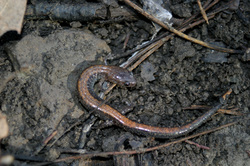
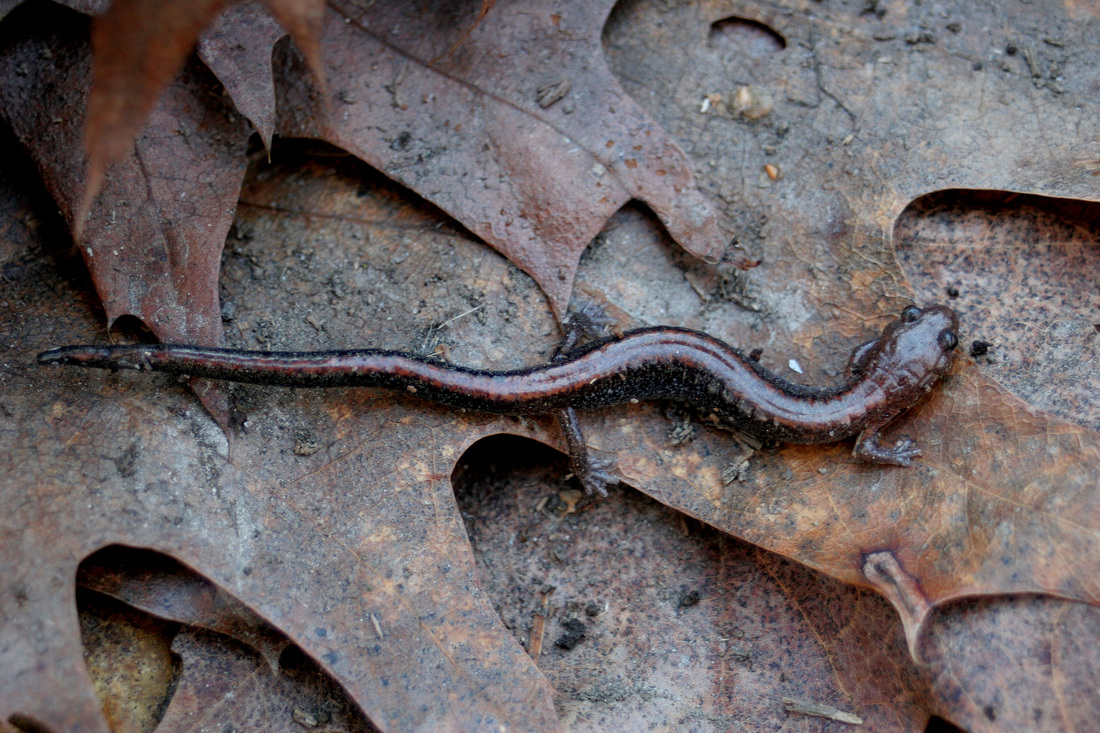
Red-backed Salamander

Red-backed salamander
 
Nature holds many surprises. Take the red backed salamander (Plethodon cinereus) for instance. In its chosen environment, damp, cool woods throughout Eastern North America, it is so abundant that if you were to weigh all of the deer and then weigh all of these salamanders in the same area the salamanders would outweigh the deer! Yet very few people ever see one of these amphibians.
 
When you think of amphibians, frogs and toads come immediately to mind. These are the ones we typically encounter in ponds, along rivers and in the case of toads our gardens. Our North American frogs serve as the stereotypical image of what an amphibian is. They go through a life cycle that begins with eggs laid in water, hatch out as gill-breathing tadpoles then change into air breathing adults who spend their adult lives living in or near water. This is not really an accurate picture of course because even among the world's frog species there are huge variations on this basic pattern.
 
The other group of amphibians that comes to mind is the salamander-newt family. Many assume, based on their knowledge of frogs, that this family lives a similar life-style. Some do, but the red-backed salamander certainly has some more surprises for us.
 
It is a hardy woodland salamander. So hardy in fact that it is active on warm winter days when other amphibians are hibernating. This salamander unlike most other amphibians migrates to communal burrows several centimeters below the surface. When it emerges it returns to its home territory of about 0.2 to 0.3 meters squared. That translates into up to four salamanders for every 4 square meters of forest floor. They live under rocks, fallen trees and prey on insects, worms and other invertebrates living in the leaf litter. They capture by using their sticky tongues.
 
They do not mate in water and in fact avoid it where they can. They mate on land in the spring and in the fall. The mail deposits his spermatophore near the female. This small packet contains his sperm but it is not deposited in her. She either rejects it or chooses it based on the vigour of his mating dance. Even then fertilization may be delayed for several weeks or months. Eggs are laid in clusters of 3 to 13 in moist, rotting cavities. The female defends them and turns them regularly.
 
There is no gill stage in this species of amphibian and a few weeks after hatching the young resemble small adults. Until they set off on their own their mother continues to guard them. She will mate every two years.
 
It will be two years before the young are sexually mature.
 
In these days of global warming, the other surprising thing is that here in Eastern Canada there are any of these salamanders at all. During the last ice age the nearest suitable habitat for these animals was at least several hundred kilometers to the south. These small 13 centimeter amphibians have had to slowly migrate north to claim renew habitats. No small feat considering the ice age melting left behind the Great Lakes as a barrier.
​
​
​​Note: A version of this article first appeared in Bob Izumi's Real Fishing Magazine in
​Dave's column At the Water's Edge. It is used with the permission of editor.
Picture

All images  and text are copyright © 2016 J.D. Taylor Senses of Wildness Inc. These images may not be used in any form without permission. All rights reserved.
© COPYRIGHT 2015. ALL RIGHTS RESERVED.
  • About
  • Books
  • eBooks on Amazon Kindle
    • Kindle Lifestories Series
    • Kindle To Be Seen or Not To Be Seen
  • SW YouTube Resources
    • SW YouTube Play Lists
    • Riverwood Mississauga Videos
    • Videos by Curriculum List
    • SW Videos by Curriculum
  • Wild Talks with Dave
    • Other Talks
    • Discovery Talks by Dave
    • Talks (Fee based)
    • Some Talks Delivered
  • Media
    • Blogs
    • Photos >
      • Nature Photography Resources
      • Africa
      • Europe
      • North America
      • South America
      • Australia
    • Illustrations
    • Videos >
      • North American Videos
      • Africa Videos
  • Black Bears A Natural History
    • Black Bears Behind the Scenes
    • Black Bears I Have Known >
      • Rosie: Mother of Generations
      • Floppy
      • Ontario's Bears
      • Behind The Image
    • Black Bears: Book Orders
  • Education Support
    • Turtles >
      • Turtle Questions
      • Turtle Answers
      • Turtle Resources
      • Midland Painted Turtle
      • Red-eared Slider
      • Common Snapping Turtle
    • Media Literacy
    • Types of Videos
    • Talks and Visits
    • Questions for Elementary Curriculum >
      • Questions About Wildlife
      • Questions for Grades 1-3
      • Questions for Grades 4-6
      • Questions for Grades 7-8
      • Questions: Birds Nesting
      • Questions: Bird Behaviour
      • Birds at a Feeder Questions
    • Notes on Answers >
      • Answers
      • Answers to Grade 1-3 Questions
      • Answers to Grade 4-6 Questions
      • Answers to Intermediate Questions
      • Notes on Salmon
      • Answers to "Bird's Nests"
      • Birds at a Feeder Answers
      • Bird Feeder Resources
      • Answers About Wildlife
  • Contact
  • Birds and Birding
    • Raptors
  • Blog
  • Safari 2024 Letter
  • Safari 2024 Trip Websites